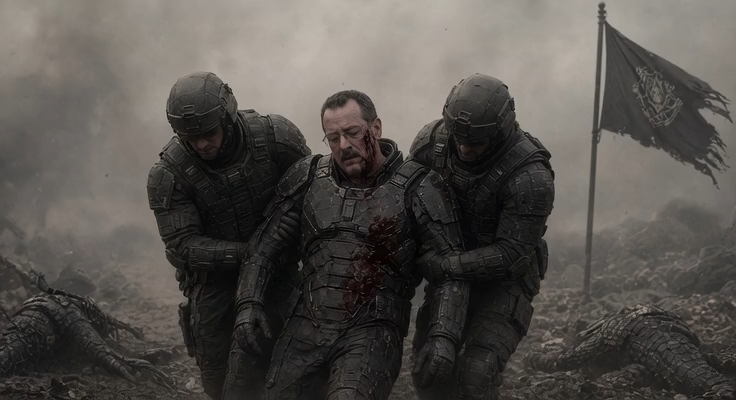
“I should say sincerity, a deep, great, genuine sincerity, is the first characteristic of all men in any way heroic.”
Thomas Carlyle
And in our story from future past….
A Music Video
Carlye’s Great Man Theory
Thomas Carlyle wrote, “The History of the world is the Biography of great men.” In a nutshell, this is the “Great Man Theory” of history. The subject of greatness involves us in puzzles and moral complexities. Yet Carlyle is useful because he is brimming with insights.
As the Story of Black Eugene gives us a villain to contemplate, shouldn’t we have a hero to set on the opposite side? What is heroic? Why are we presently overrun with celebrities who are mistaken for heroes? What makes a great man? Does a great man have to read books? Somone put these questions to me last week. In answer to him, I composed and produced the music video above. Yet my idea of heroic behavior is hardly the end-all and be-all.
While attempting to answer a reader’s query about Great Men, I referred to Carlyle. The reader seemed to react negatively to the fact that in Carlyle’s book on heroism he listed Mahomet as a Great Man. How could this be? I replied that Carlyle’s judgments are sometimes controversial. Yet Carlyle had a definite scheme in mind when he chose Mohamet as a hero. According to Carlyle, heroes are people who are not the creation of their environment; rather, they are the creators and shapers of their environment. In this context, Carlyle enumerated six heroic guises: divinity, prophet, poet, priest, man of letters, and king. Keeping in mind that heroes are makers of the world rather than made by the world, Carlyle chose the following representatives of greatness: Odin, Mahomet, Shakespeare, Luther, Johnson, and Napoleon.
The qualification of greatness being a man who shapes the world as opposed to being shaped by helps the clarify a few things. However, it also creates a problem for us. If greatness belongs to those who shape the world, then Lenin, Stalin, Mao and Hitler would be Great Men. However, Carlyle offers us some qualifiers. He says that the Great Man is essentially sincere. At one point Carlyle wrote, “I wish you to take this as my primary definition of a Great Man.”
The other qualification of a Great Man set down by Carlyle was something many people would find difficult. He said that a Great Man sees into the nature of things. He has the gift of discernment. This is most clearly seen in prophets, and this is something Carlyle attempts to demonstrate in the biography of Mahomet, whether we ultimately agree with him or not.
Last but not least, Carlyle thought that a Great Man is someone who meets some essential need of his time. Furthermore, he is capable of destructive and creative acts. Such acts, on his part, are not arbitrary or drawn from egotism. It is in these qualities that primitive man saw Great Men as divinities. And it is no accident that some antiquarians came to believe that the original gods of Egypt, Mesopotamia and Greece were merely Great Men.
Carlyle seems to say that Great Men are only raised up when Providence is in need of them. Perhaps the normal course is for Great Men to get ground under by inferior men, since inferior men are unable to stand greatness at close quarters (insofar as greatness puts them to shame). Here we see the character of Black Eugene in high relief. Carlyle takes this as a realistic point of departure. Since heroes, possessing greatness within themselves, are subject to persecution for their good qualities, they are only called forth if (1) the right circumstances arise and (2) God is willing.
In terms of literary men, Carlyle made an unusual suggestion,
“Literature, so far as it is Literature, is an ‘apocalypse of Nature,’ a revealing of the ‘open secret.’ It may well be named, in Fichte’s style, a ‘continuous revelation’ of the Godlike in the Terrestrial and Common. The Godlike does ever, in very truth, endure there; is brought out, now in this dialect, now in that, with various degrees of clearness: all true gifted Singers and Speakers are, consciously or unconsciously, doing so.”
In conclusion it is worth adding that Carlyle thought Great Men could lose their greatness and fail. This is how he interpreted Napoleon’s career. In this and other points we find that the subject of Great Men is far from exhausted, being exhaustible.

Leave your thoughts